Showing posts with label Porosity. Show all posts

Tuesday, December 26, 2017

Calculate Neutron - Density Porosity - Shale Corrected - Dewan (1983)

💻 Optimized Version 📱

List of equations assignment

Neutron-Density Combinaton Porosity- Shale corrected- Dewan (1983)

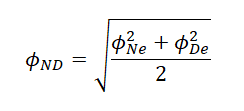
Dewan (1983) also proposed a shale correction to porosity values obtained from the combination of neutron and density well logs. This expression is represented as the square root of the sum of the squared shale corrected porosity values of each well log (neutron and density). The ecuation is expressed the following way:
Neutron-Density Porosity- Shale corrected- Dewan (1983)
    Where:
  • ɸND= neutron-density porosity- shale corrected
  • ɸDe= density porosity- shale corrected
  • ɸNe= neutron porosity- shale corrected


Porosity - Neutron-Density (ɸnd) - Shale corrected- Dewan (1983)

Made by Henry Herrera

Calculate Density Porosity - Shale Corrected - Dewan (1983)

💻 Optimized Version 📱

List of equations assignment

Density Log Porosity- Shale Corrected - Dewan (1983)

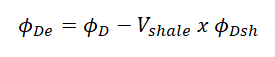
As for the neutron log case, Dewan (1983) proposed a correction for the porosity derived from the density log, taking into consideration the shale volume value and the density value of a nearby shale at the interest depth. The equation is the following:

Density Log Porosity- Shale Corrected - Dewan (1983)
    Where:
  • ɸD= density log porosity
  • ɸDe= density log porosity- shale corrected
  • ɸDsh= density log porosity in a nearby shale
  • Vshale= shale volume


Calculate Density Log Porosity (ɸde) - Shale Corrected- Dewan (1983)

Made by Henry Herrera

Calculate Neutron Porosity - Shale Corrected - Dewan (1983)

💻 Optimized Version 📱

List of equations assignment

Neutron Log Porosity - Shale Corrected -Dewan (1983)

Dewan (1983) also proposed an equation for shale correction of the porosity values derived from neutron well logs, and in the equation, it is included the shale volume value and the neutron porosity value of a nearby shale at the depth of interest. The equation is the following:

Neutron Log Porosity - Shale Corrected - Dewan (1983)
    Where:
  • ɸNe= neutron log porosity - shale corrected
  • ɸN= neutron log porosity
  • ɸNsh= neutron log porosity in a nearby shale
  • Vshale= shale volume


Calculate Neutron Log Porosity (ɸne) - Shale Corrected Dewan (1983)

Made by Henry Herrera

Calculate Density Porosity - Shale Corrected - (Schlumberger, 1975)

💻 Optimized Version 📱

List of equations assignment

Density Log Porosity - Shale Corrected - Schlumberger (1975)

Schlumberger (1975) also proposed a shale correction for porosity values derived from density logs. In this case, the equation includes density value of a nearby shale at the depth of the study area, and shale volume. The expression is the following:

 Density Log Porosity - Shale Corrected - Schlumberger (1975)
    Where:
  • ɸDe= density log porosity - shale corrected
  • ɸD= density log porosity
  • ɸDshale= density log porosity in a nearby shale
  • Vshale= shale volume


Calculate Density Log Porosity (ɸde) - Shale Corrected- Schlumberger (1975)

Made by Henry Herrera

Calculate Neutron Porosity - Shale Corrected (Schlumberger, 1975)

💻 Optimized Version 📱

List of equations assignment

Neutron Porosity (ɸne)- Shale Corrected- (Schlumberger, 1975)

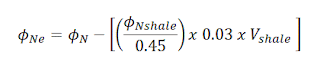
In 1975, Schlumberger also proposed an equation for the calculation of neutron derived porosity including shale corrections, which takes into account the porosity value in nearby shale and shale volume. The expression is the following:

Neutron Porosity (ɸne)- Shale Corrected- (Schlumberger, 1975)
    Where:
  • ɸNe= shale-corrected neutron porosity
  • ɸN= neutron derived porosity
  • ɸNshale= neutron porosity at a nearby shale
  • Vshale= shale volume


Calculate Neutron Porosity (ɸne) - Shale Corrected- Schlumberger (1975)

Made by Henry Herrera

Calculate Sonic Porosity - Shale Corrected (Dewan, 1983)

💻 Optimized Version 📱

List of equations assignment

Sonic Derived Porosity- Shale Corrected - Dewan (1983)

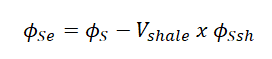
Dewan (1983) proposed a simple equation to make the shale correction to the value obtained from sonic derived porosity, where he considered shale volume and the sonic porosity in a nearby shale at the depth of the study area. The equation is the following:

Sonic Derived Porosity- Shale Corrected - Dewan (1983)
    Where:
  • ɸSe= effective (shale-corrected) sonic porosity
  • ɸS= sonic porosity
  • ɸSsh= sonic porosity in a nearby shale
  • Vshale= shale volume


Calculate Sonic Derived Porosity - Shale Corrected- Dewan (1983)

Made by Henry Herrera

Calculate Sonic Porosity - Shale Corrected (Dresser Atlas, 1979):

💻 Optimized Version 📱

List of equations assignment

Sonic Derived Porosity- Shale Corrected - Dresser Atlas (1979)

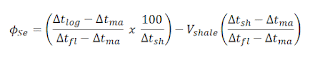
Dresser Atlas (1979) created an equation to calculate the shale corrected sonic derived porosity, using Wyllie (et al., 1958) equation as the basement, and considering the shale volume and sonic porosity in a nearby shale values. The expression is the following:

Sonic Derived Porosity- Shale Corrected - Dresser Atlas (1979)
    Where:
  • ɸSe= effective (shale-corrected) sonic porosity
  • ɸS= sonic porosity
  • ɸSsh= sonic porosity in a nearby shale
  • Vshale= shale volume
  • Δtlog= interval transit time of the formation (from the sonic log)
  • Δtma= matrix interval transit time
  • Δtfl= fluid interval transit time
  • Δtsh= interval transit time in a nearby shale


Calculate Sonic Derived Porosity - Shale Corrected - Dresser Atlas (1979)

Made by Henry Herrera

Calculate Resistivity Porosity - Flushed Zone - Residual Hydrocarbons Correction

💻 Optimized Version 📱

List of equations assignment

Resistivity derived porosity - Flushed Zone - Residual Hydrocarbons Correction

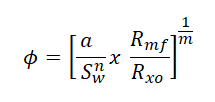
For the calculation of resistivity derived porosity at the flushed zone, there are cases where a residual hydrocarbons correction needs to be made. In this case, water saturation of an uninvaded zone and the saturation exponent valuesneed to values must be known. The expression is summarized as the following:

 Resistivity porosity - Flushed Zone - Residual Hydrocarbons Correction
    Where:
  • ɸ= porosity
  • a= tortuosity factor
  • Sw= water saturation of the uninvaded zone
  • m= cementation exponent
  • n= saturation exponent
  • Rmf= resistivity of the mud filtrate at formation temperature
  • Rxo= shallow resistivity from a very shallow reading device such as lateolog-8, microspherically focused log, or microlaterolog


Calculate Resistivity Porosity (ɸ) - Flushed Zone- Residual Hydrocarbons Correction

Made by Henry Herrera

Calculate Resistivity Porosity - Flushed Zone Rxo

💻 Optimized Version 📱

List of equations assignment

Resistivity derived porosity (ɸ) - Flushed Zone Rxo

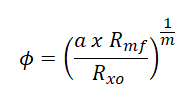
At the flushe zone, resistivity derived porosity can also be calculated. In this case, resistivity of the mud filtrate at formation temperature must be know and the shallow resistivity from a very shallow reading device, besides the tortuosity and cementation exponent values. The equation is expressed the following way:

 Resistivity derived porosity (ɸ) - Flushed Zone Rxo
    Where:
  • ɸ= porosity
  • a= tortuosity factor
  • m= cementation exponent
  • Rmf= resistivity of the mud filtrate at formation temperature
  • Rxo= shallow resistivity from a very shallow reading device such as lateolog-8, microspherically focused log, or microlaterolog


Calculate Porosity (ɸ)

Made by Henry Herrera

Calculate Resistivity Porosity - Sw = 1

💻 Optimized Version 📱

List of equations assignment

Resistivity derived porosity (Sw= 1)

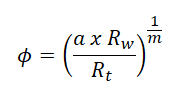
In water bearing zones, where water saturation equals a 100% (Sw= 1), Archie's equation for resistivity derived porosity, is shorten because it is not neccesary to use water saturation because equals 1, neither the saturation exponent, and it is simplified as the following expression:

 Resistivity Porosity sw= 1
    Where:
  • ɸ= porosity
  • Rw= resistivity of formation water at formation temperature
  • Rt= true formation resistivity (i.e., deep induction or deep laterolog corrected for invasion)
  • a= tortuosity factor
  • m= cementation exponent


Calculate Resistivity derived porosity (ɸ) - Sw = 1

Made by Henry Herrera

Calculate Resistivity Porosity

💻 Optimized Version 📱

List of equations assignment

Resistivity derived porosity (resistivity porosity)

Starting from the well known Archie's equation, regularly known better for water resistivity calculations, it is also used for the resistivity derived porosity. This equation includes the values of tortuosity factor, formation and water resistivities, water saturation, and saturation and cementation exponents, and the expression is the following:

Resistivity Porosity
    Where:
  • ɸ= porosity
  • Sw= water saturation of the uninvaded zone
  • Rw= resistivity of formation water at formation temperature
  • Rt= true formation resistivity (i.e., deep induction or deep laterolog corrected for invasion)
  • a= tortuosity factor
  • m= cementation exponent
  • n= saturation exponent


Calculate Resistivity derived Porosity (ɸ)

Made by Henry Herrera

Calculate Neutron - Density Porosity

💻 Optimized Version 📱

List of equations assignment

Neutron-Density Combination Porosity: Gas detection

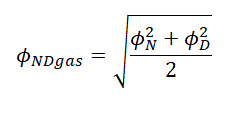
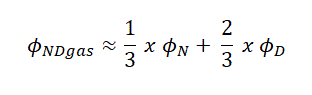
In gas bearing formations, a combination is made between the values obtained from neutron and density logs. For those who know about wells, it is known that when the curves of both logs cross between (crossover), we can infer the presence of a gas accumulation, although other paramaters neeed to be taken into account like well bore conditions (caliper log), among others. The expression is the following:

Neutron Density 1
    Where:
  • ɸNDgas= gas bearing formations porosity
  • ɸN= neutron log porosity
  • ɸD= density log porosity

Calculate Neutron-Density Combination Porosity (ɸnd)

The following equation also allow us to obtain a similar value to the first equation:

 Neutron Density Porosity 2

Calculate Porosity - Density- Neutron (2) (ɸnd)

Made by Henry Herrera

Calculate Density Porosity

💻 Optimized Version 📱

List of equations assignment

Porosity - Density Log

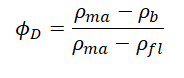
For the calculation of porosity derived from density logs, the equation takes into account the density values of the matrix and fluid (previously known from literature), and the formation density of the study area. The expression is the following:

density porosity
    Where:
  • ɸD= density log porosity
  • ρma= matrix density
  • ρb= bulk formation density
  • ρfl= fluid density


Calculate Density Log Porosity (ɸd)

Made by Henry Herrera

Calculate Sonic Porosity - Hydrocarbons Effect

💻 Optimized Version 📱

List of equations assignment

Sonic Derived Porosity- Hydrocarbons Correcction

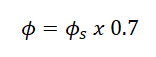
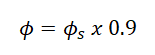
Hydrocarbons generate an effect at the time of estimating porosity from sonic well log tools. Oil and gas create an increasing or decreasing effect of the real value of porosity. That is the reason why sonic derived porosity values must be multiplied by a correction factor depending on the type of hydrocarbon.

Sonic Derived Porosity- Oil Effect

Sonic Derived Porosity- Hydrocarbons Correction
    Where:
  • ɸs= Sonic Log Derived Porosity


Calculate Sonic Derived Porosity- Oil Effect

Sonic Derived Porosity- Gas Effect

Gas Effect

Calculate Sonic Derived Porosity- Gas Effect

Made by Henry Herrera

Calculate Sonic Porosity - Unconsolidated Formations

💻 Optimized Version 📱

List of equations assignment

Sonic Porosity- Unconsolidated Formations

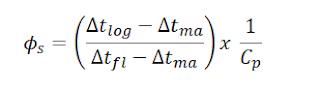
To calculate sonic porosity for unconsolidated formation, we can start by getting the product of the Wyllie et al. (1958) sonic porosity equation with the inverse expression of a compaction factor. The equation is the following:

Sonic Porosity- Unconsolidated Formations
    Where:
  • ɸs= sonic porosity
  • Cp= compaction factor
  • Δtma= matrix interval transit time
  • Δtlog= interval transit time of the formation (from the sonic log)
  • Δtfl= fluid interval transit time


Calculate Sonic derived Porosity - Unconsolidated Formations

Compaction Factor (Cp)

Compaction factor is calculated from the following equation, which takes into account the sonic porosity at a nearby shale:

    Where:
  • Δtsh= interval transit time in a shale adjacent to the formation of interest
  • C= a constant which is normally 1.0 (Hilchie, 1978)


Calculate Compaction Factor (Cp)

Made by Henry Herrera

Contact Form

Name

Email *

Message *

Popular Posts